
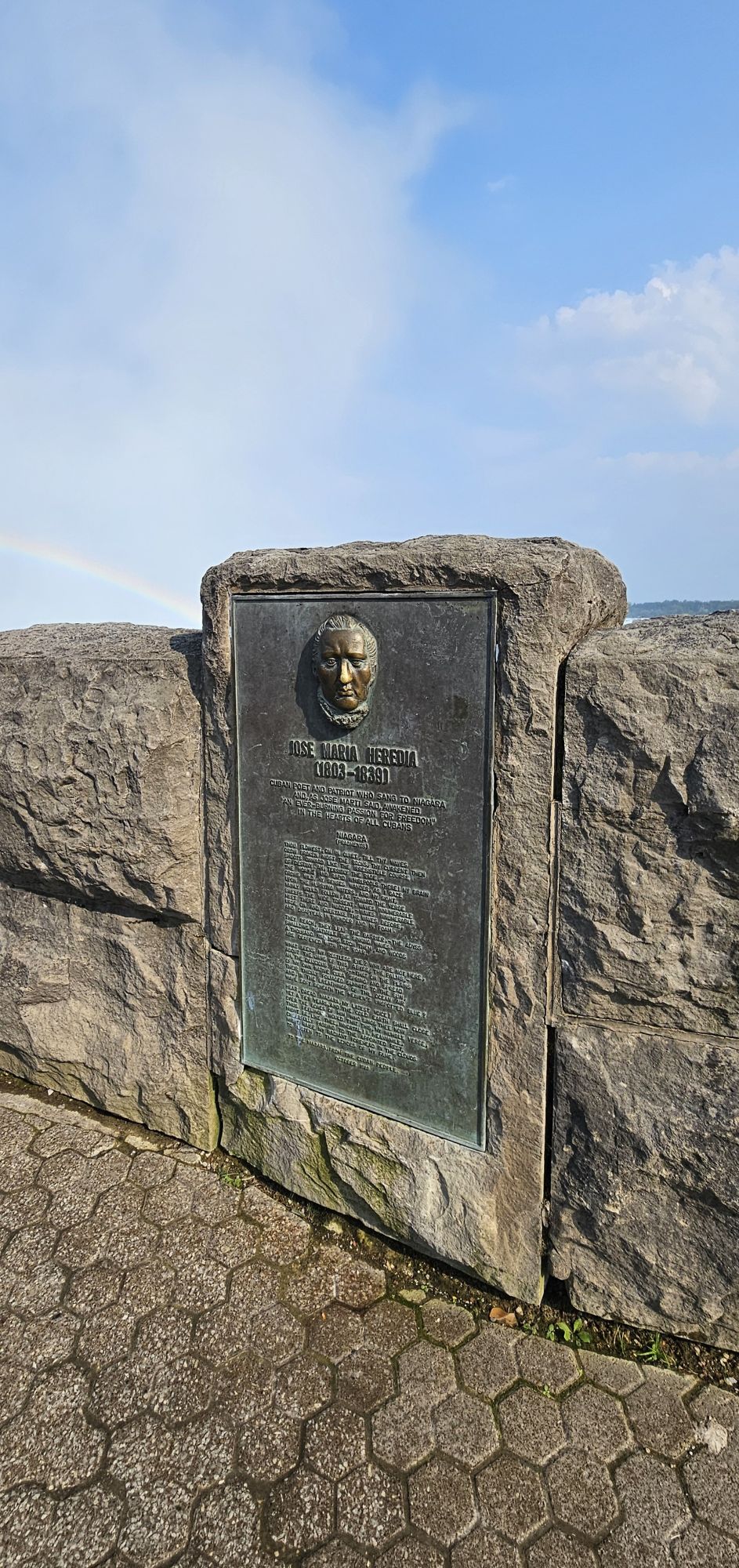
A Cuban Poet at Niagara Falls
Dear Jane,
Today is my Abuela’s 100th birthday! Feliz cumpleaños Abuela!

For this epic milestone, I made a trip to Niagara Falls earlier this month to visit the plaque dedicated to José María Heredia, Cuba’s first national poet. Seeing this plaque was a lifelong goal of Abuela’s that she didn’t get to achieve, and I wanted to “gift” it to her in a sense.
As a student, Heredia had ideologies that conflicted with Spain’s rule of Cuba, and he faced a trial that resulted in his exile. He traveled north from Cuba to Canada and saw Niagara Falls. This natural wonder compelled him to write the ode, Niagara.
My great-grandmother used to make her children memorize and recite literature, and that’s how Abuela became obsessed with Heredia’s Niagara and Niagara Falls. At 8 years old, she found it in a book of poetry and can still recite it from memory today! I recorded a conversation with Abuela about this, and she told me that she declared to her mother, “The day I see Niagara Falls, I can die.”
“I am worthy to contemplate you: always
disdaining the common and petty,
I longed for the terrifying and sublime.
As the furious hurricane crashed down,
as the lightning thundered upon my
forehead,
I throbbed, rejoicing. I saw the ocean,
lashed by the stormy south wind,
batter my ship, and
open its abysses before my feet, and I loved
the danger,
and I loved its wrath; but its fierceness did
not leave the deepest impression
on my soul that your greatness did. You run
serene and majestic, and then, broken into
the harsh rocks, you rush violently,
enraptured, like irresistible and blind destiny.”
Niagara was the impetus for Abuela and Abuelo moving to the United States accidentally. They planned to see Niagara Falls and Heredia’s plaque on their honeymoon in the mid-1950s, but they didn’t have enough money to make it past New York City.
In New York, they stayed with a friend of Abuela’s aunt in Yonkers and then rented a room from a friend of Abuelo’s in Manhattan. They each found a job within two weeks of moving to Manhattan and decided to stay and save up money to buy a little house in Cuba. Abuela then became pregnant with my mom and her twin sister. Their birth required an emergency c-section. My great-grandparents traveled to New York to be there for their birth and ultimately returned to Cuba with my mom and her sister so that Abuela could return to work and help Abuelo pay off the hospital bills. That was July 1958.

The bills were paid by mid-December, and Abuela used their last $80 to return to Cuba to visit her daughters. $80 was exactly enough for a Greyhound bus to Key West and the ferry to Havana. Fidel Castro’s revolution succeeded on New Year’s Eve and Abuelo and Abuela decided to stay in New York for good.
I’d been to Niagara Falls before, for a brief 40 minutes in October 2023. During that short time, I was amazed, just by the side of the American Falls. This time, I saw everything from every angle.
“Mighty Niagara!
Hear my last voice: in a few years
the cold grave will have devoured
your weak singer. May my verses last like your immortal glory! May
some traveler, contentedly contemplating
your face,
breathe a sigh in my memory.”
There was a lot of contemplation on my part. After seeing some information about the history of the falls and erosion, I had realized that I wasn’t looking at the same waterfalls that Abuela had seen when she finally made it to Niagara Falls in the 1970s. And neither of us had been looking at the same thing Heredia had written a poem about 200 years ago.
“I look at your waters tirelessly flowing
like the long torrent of centuries
rolling along into eternity.”
The falls recede 3-12 inches per year. During their lifetime, they have receded 7 miles upriver from Lake Ontario.

Today, the flow of water is completely controlled by Canada and the United States. Each country has a hydroelectric power plant on their respective side of Niagara River, and with water flow controlled, they reduce the amount of erosion but can’t stop it completely. Though they have also contributed to it deliberately. Terrapin Point on Goat Island used to be more of a point, but it was destroyed upon discovery of weak bedrock when the water flow had been stopped for the American Falls.
This was a short but incredibly thought-provoking trip. I thought the most Cuban thing about Niagara Falls was my Abuela’s connection to a nearly forgotten exiled Cuban poet. But the more I dwelled on the poem and learned the history of the Falls, the stronger the connection. The heat, the power plant ruins, the way erosion and time reshape everything. Havana and its erosion came to mind. Abuela’s grand Havana is still recognizable, even as it falls apart from neglect and time, and the Falls look timeless, even as they reshape themselves every second.
<3 Katherine


One response to “Niagara Falls Through Cuban Eyes”
Thanks for sharing this! Such an interesting read. Happy 100th Birthday to your Abuela! 💖