
Discovering Family History in Havana, Cuba
Dear Jane,
For most of my life, Abuela had warned us never to go to Cuba, but she started softening up on that stance when she hit her nineties. Instead of Cuba being a terrible place (thanks, Communism), she started talking about how beautiful it was and started telling more stories about her life there
I was relieved when she said, “You should go someday.” Though she’s 100 now, I’m not unconvinced that she’s going to outlive her children and grandchildren. And until she gave her blessing in an offhand comment, I really thought that I was going to have to wait for her to pass before seeing Cuba, and that’s if the U.S. government was in a traveling mood.

Three months into my new job working in Travel for a small, family-owned tour operator, I was assigned to go to Cuba as a junior tour director for the first time. I was so excited to tell Abuela. She was very happy, but also a little sad, knowing that the Cuba I would see was not the Cuba she knew and loved.
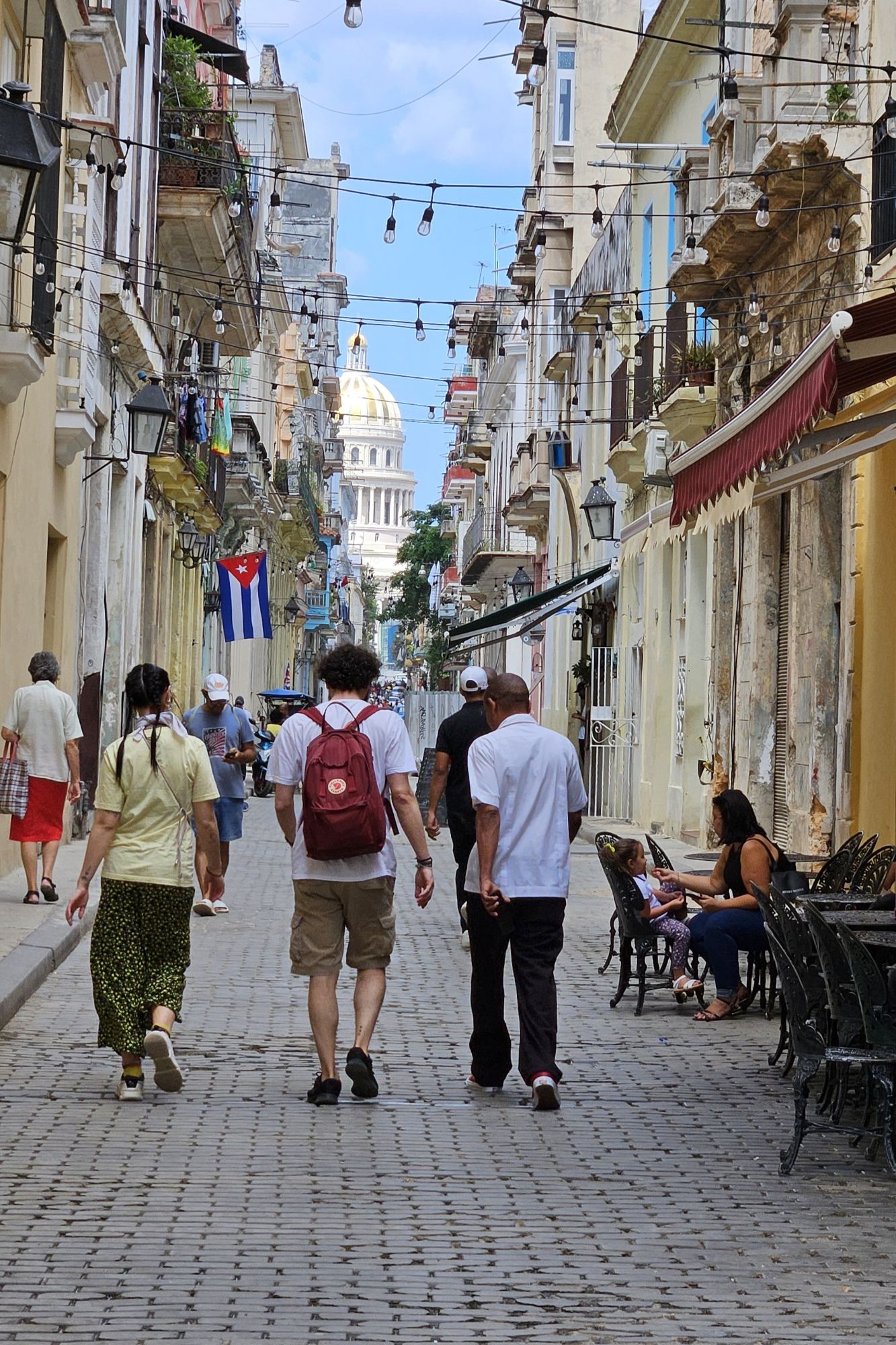
Havana is a decaying city that is also moving through time at a glacial pace. There is more of a skyline compared to when Abuela last lived there, and during this first visit, there was a glass and metal 40-story, 542-room hotel being constructed. (This building has since been completed and sits empty.) All of the other buildings are on the verge of falling apart, except for those involved in the tourist sector.

I traveled to Cuba with a university alumni group, and the director of their travel program was with us to check out our operations there. She was very on top of my colleagues and me the whole time, and I wondered if I might not be able to sneak away during a break to find the house my Abuela grew up in.
In anticipation of this trip, I’d really put in a lot of work building up the excitement for myself. I recorded interviews with Abuela and did some Googling, which led to my purchase of El Viaje Más Largo by Leonardo Padura.
Padura is a Cuban journalist born after the revolution and who grew up in the same neighborhood as Abuela. El Viaje Más Largo is a collection of essays from Padura’s life, and there’s a whole chapter dedicated to El Castillo de Averhoff, Abuela’s house.
El Castillo was built as a country party house for Octavio Averhoff and his bride. Averhoff was the rector of the University of Havana. Student-led revolutions are a recurring theme in Cuban history, and Averhoff was blamed for the death of a student leader. The Averhoff family fled to Mexico from Cuba, and my great-grandfather was placed in the castle as a caretaker. He was afforded this opportunity because he was friends with the Averhoff family lawyer.
On my last full day in Cuba, we had a scheduled lunch at leisure. The senior Tour Director joined the guests for lunch as our guide whisked me away in a taxi. The driver knew a shortcut to Mantilla, one of the neighborhoods in Southern Havana. “Mantilla is the place to go if you need glass for a window,” he told me.
When Abuela lived there, it wasn’t even part of the city of Havana. She told me El Castillo had a pool and many orchards because Averhoff loved fruit and collected trees from all over the world.
We drove through some neighborhoods that were untouched by tourism and then up a hill. I would’ve held my breath the first moment the orange tiled roof of El Castillo peeked out of the trees, but the diesel fumes from the taxi were choking me already. Even so, I couldn’t believe this was actually happening.

I told my mother ‘Oh I would like to see that house inside.’ Who could tell me that I would live there sometime?
Abuela, Age 8 & 98
After asking a local for directions to the entrance, we found ourselves at a gate. El Castillo is now the board of education for Mantilla, with an armed guard at the gate who approached our taxi. Our guide knew what he was doing, though, and we were allowed in because it happened to be spring break and just a fraction of the staff were there.

I was told not to take pictures by the guard, but of course, I took some for Abuela. In fact, I printed a picture of the castle that I took from afar. It hadn’t been taken care of and suffered from aging. I didn’t want that to make her cry. Inside, where more staff appeared, I only took pictures of the floor.

The mosaic floors were the only original features of El Castillo. The grand entry, which acted as a foyer between the ballroom and library, had been stripped of its marble and now had a mural of Fidel Castro featuring quotes from him. The entrances to the ballroom and library were filled in and had regular doors.
I love castles. It’s like a castle. Beautiful. And the shingles. Red, thin. They keep red all the time because they were French. They had a swimming pool. It was beautiful. And all kinds of mangoes. No, because the man loved vegetation. He had all kinds of fruits. All the fruits that could grow in Cuba, he planted. I loved that house. The walls were marble. The floors were granito.
Abuela, Age 98
Up the stairs, the space where Abuela and her family lived had been divided into small offices, all painted aqua green. There were some dilapidated stairs leading to a third floor. Abuela said that when she lived there, there was a bat problem on that floor. I’m willing to bet that the problem is still present.
I was allowed to step onto the terrace on the second floor, where we have pictures of my mom and her twin sister as infants.
The whole experience was surreal. It was incredible to be there and to share my family history with the guide, who is now a friend. It was also a weird experience having the staff who were in that day following our every move.
When we returned to the rest of the tour group, they had all learned where the guide and I had disappeared to and wanted to know more about El Castillo and my family. They gathered around me to see what pictures I had and to hear what the experience was like. It was wonderful to end the trip on such a high.
<3 Katherine
PS – I promised my guide friend that I wouldn’t post photos of El Castillo on the internet. The artistic interpretations of it were created by my brother, @rahb_art.


2 responses to “Traveling to Cuba”
Thanks for sharing! What an incredible experience.
Loved this post! So interesting to read about your experience and the conversations with your abuela. Your brother’s art is so impressive!